 RecA
RecAICLR 2026Accepted paper
Reconstruction
Alignment Improves Unified Multimodal Models
Improving image generation
through visual understanding.
A self-supervised post-training method for unified multimodal models. RecA reconstructs images from the model’s own visual understanding features—transferring visual understanding to text-to-image generation and image editing.
01 / Text-to-image generation
From understanding to imagination.
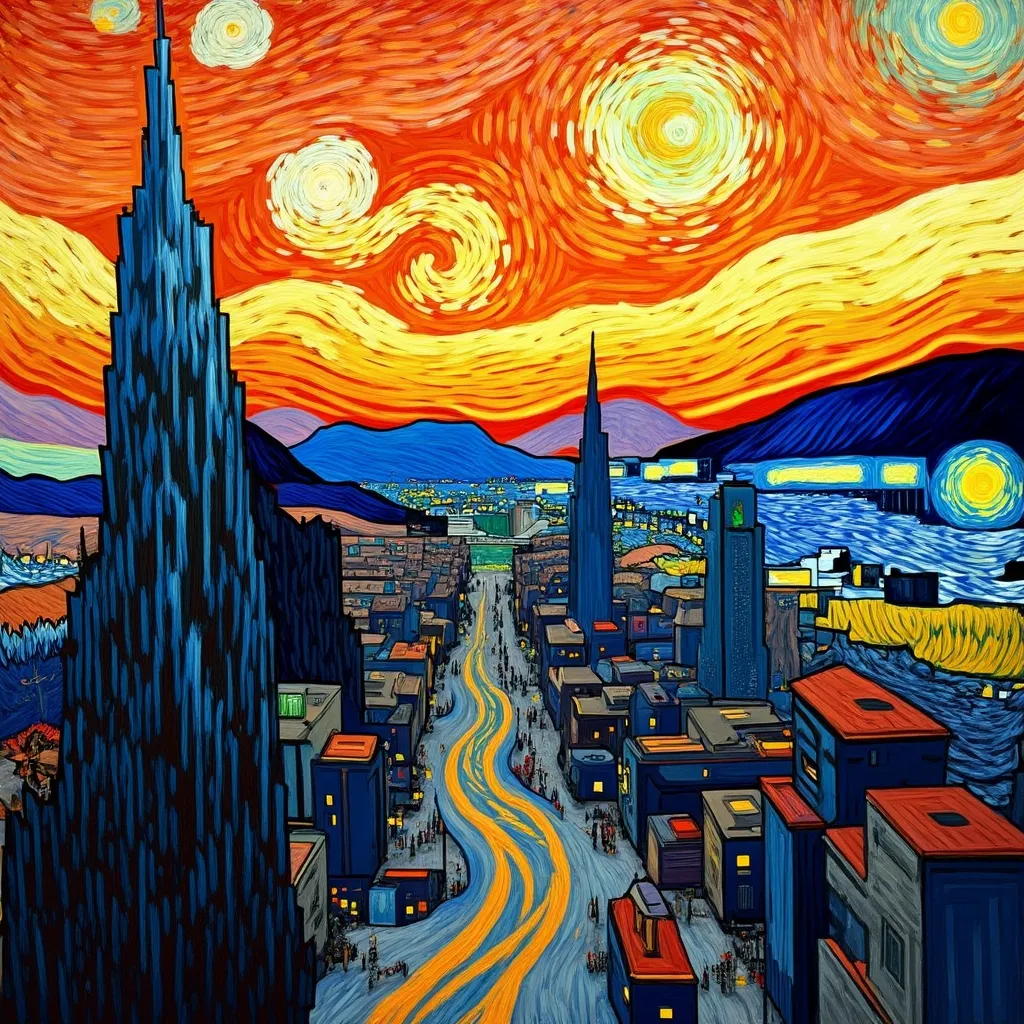
Text-to-image samples. Select an image to read its prompt.
Prompt: A Van Gogh style painting of a cyberpunk city at sunrise.
02 / Self-supervised post-training
The image itself
is the supervision.
Reconstruction Alignment (RecA) trains a pretrained unified multimodal model to reconstruct an image from its own visual understanding features, using the original image as the target.
This semantic reconstruction objective enables understanding-to-generation transfer: better text-to-image generation and image editing, with the model’s original inference interface.
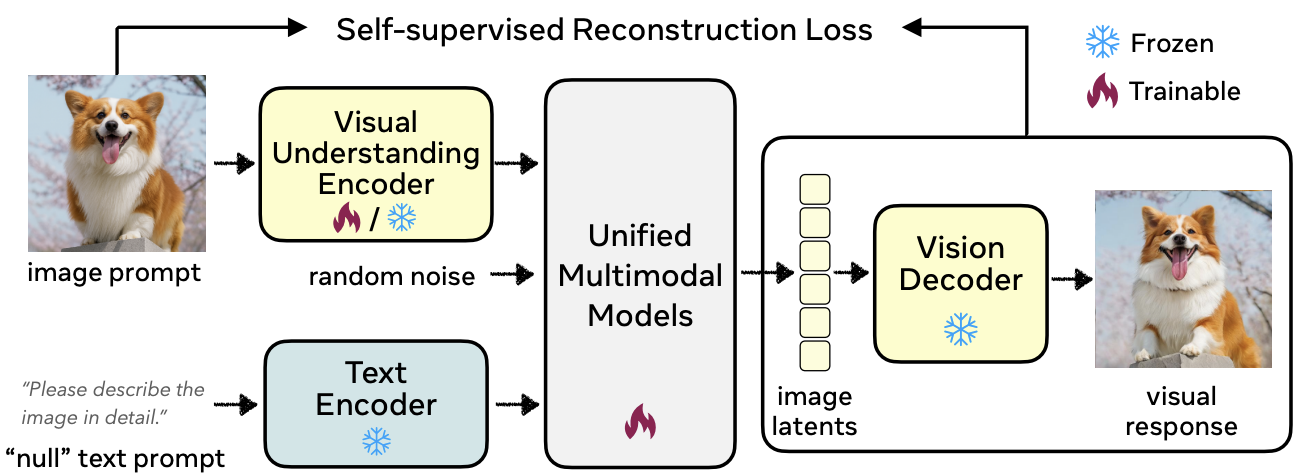
Understand the image
Use the pretrained model’s visual understanding features as the conditioning signal.
Reconstruct its semantics
A semantic information bottleneck encourages learning meaningful visual structure through reconstruction.
Transfer to generation
Use the same inference interface for text-to-image generation and image editing.
Training scope. The reconstruction objective is caption-free. Models with shared understanding and generation parameters also retain image-to-text training to preserve understanding; decoupled understanding components can remain frozen. Evaluated on Show-o, Harmon, OpenUni, and BAGEL. Architecture-specific training guide ↗
The supervision gap
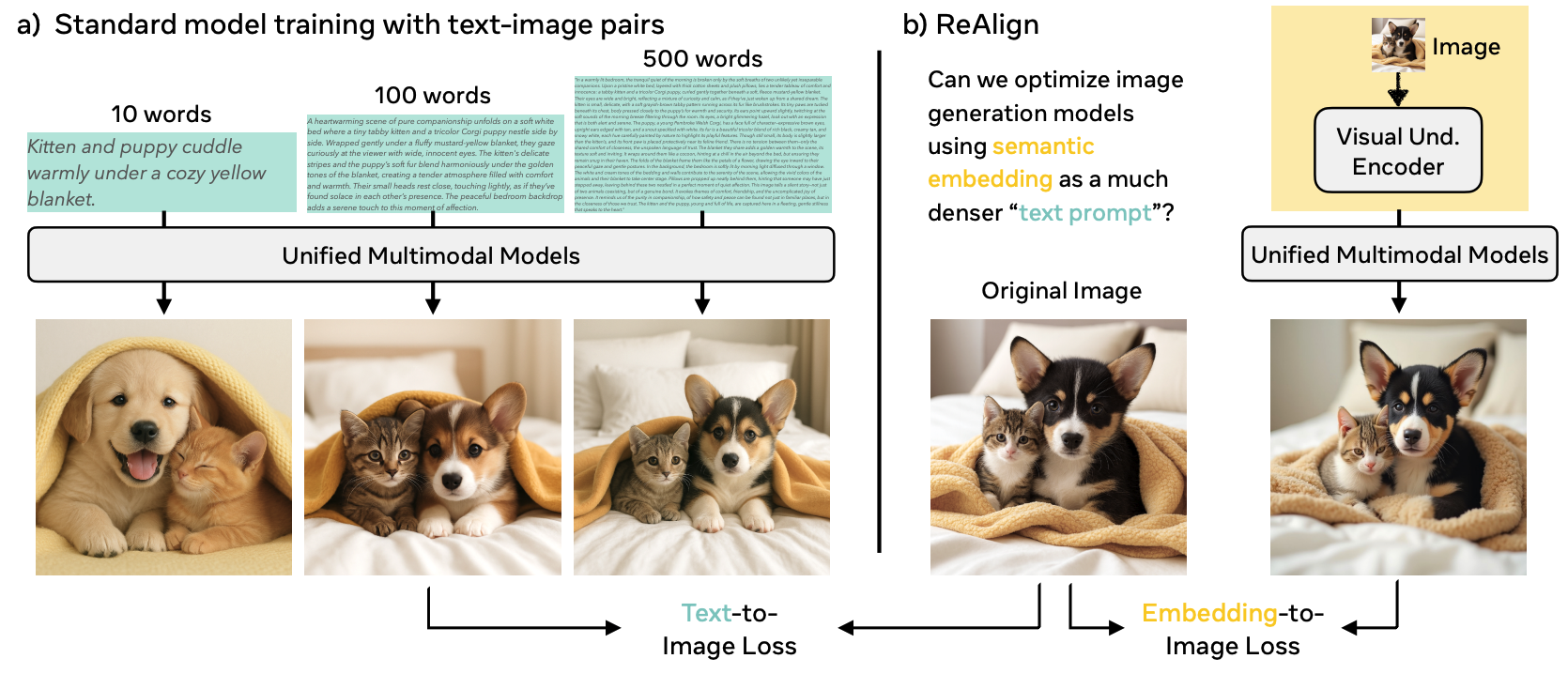
Images say more than captions.
Captions often leave out fine-grained attributes, spatial relationships, and visual details. Visual understanding features offer a denser source of supervision.
The alignment gap
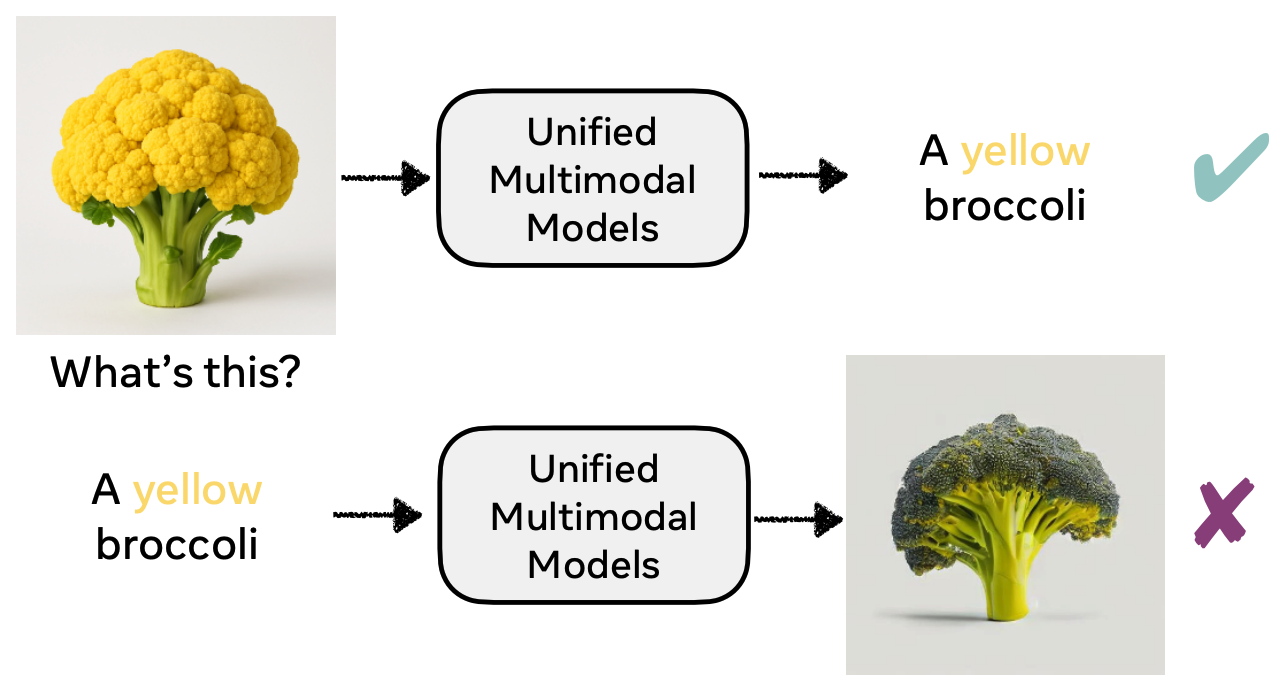
Understanding is not yet generation.
A unified model can recognize a visual concept yet struggle to generate it. RecA connects these capabilities through semantic reconstruction.
03 / Results
Better generation.
Stronger editing.
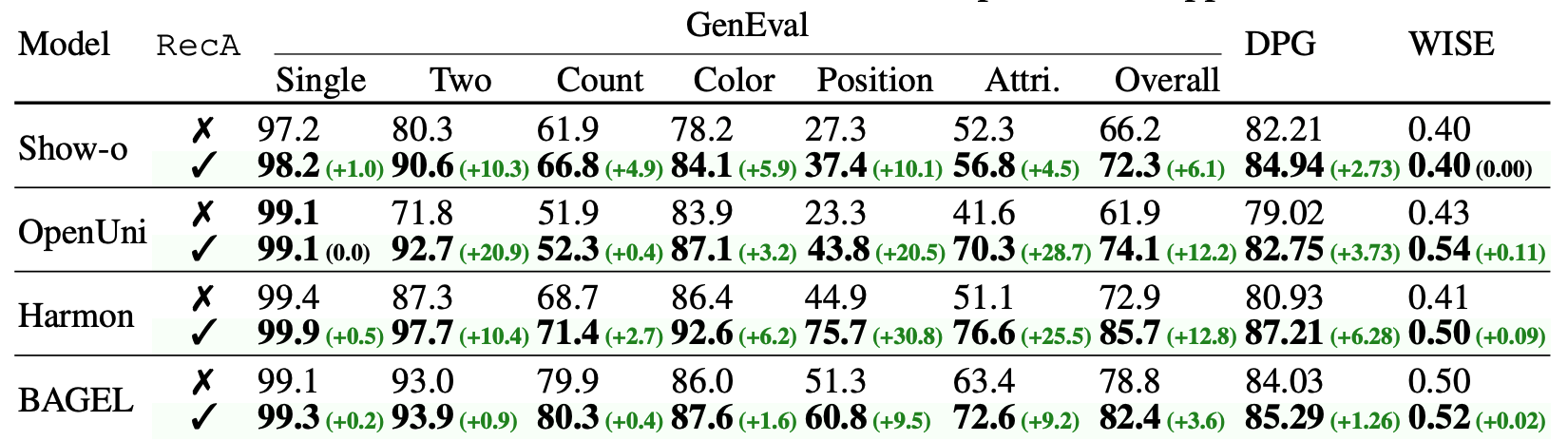
Improvements across distinct tasks and architectures, using visual understanding for generative model post-training.
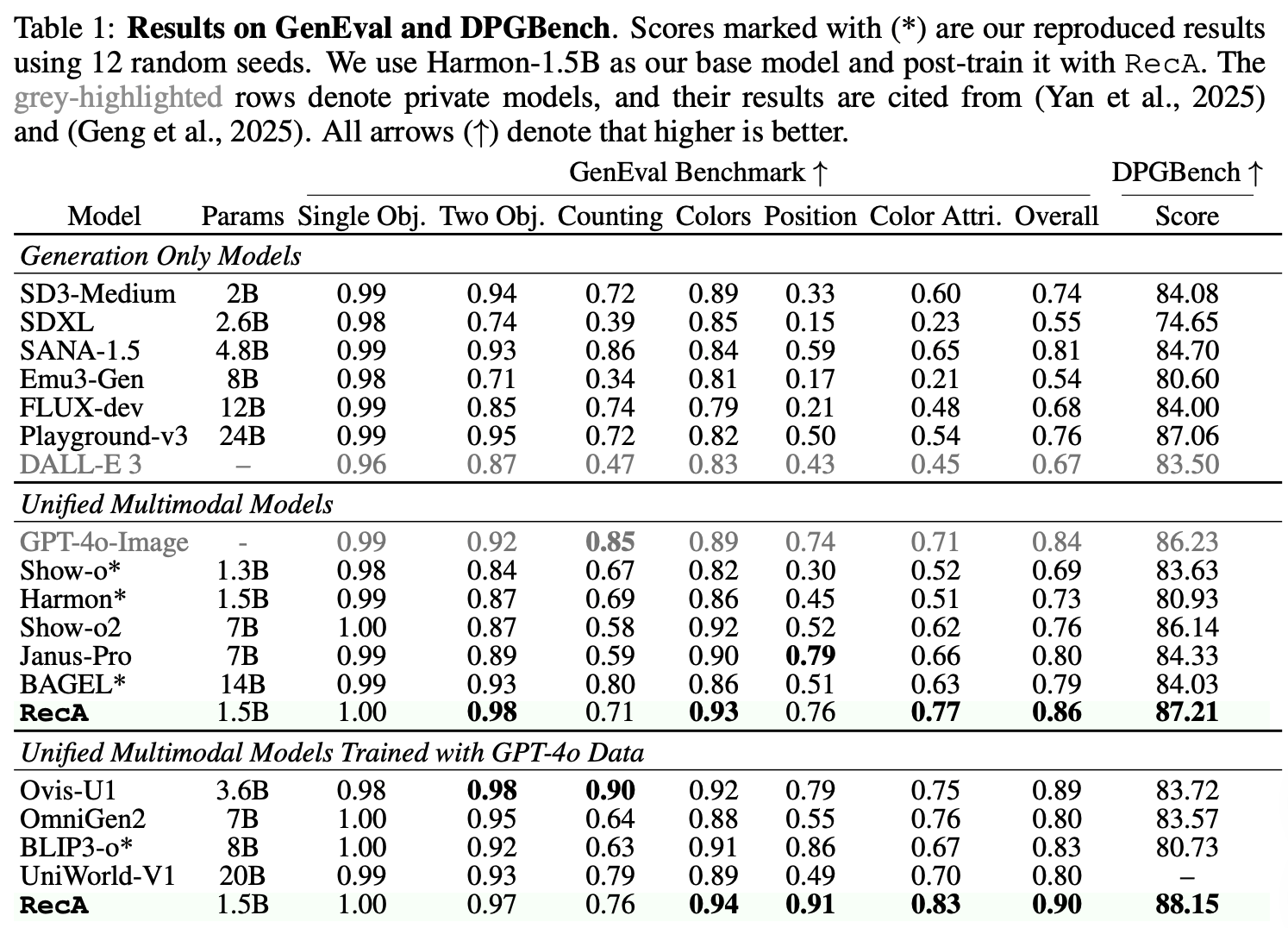
Text-to-image generation
Harmon-1.5B → Harmon-1.5B + RecA
A separate SFT → RecA recipe using GPT-4o-Image distillation data for supervised fine-tuning reaches 0.90 GenEval / 88.15 DPG-Bench.
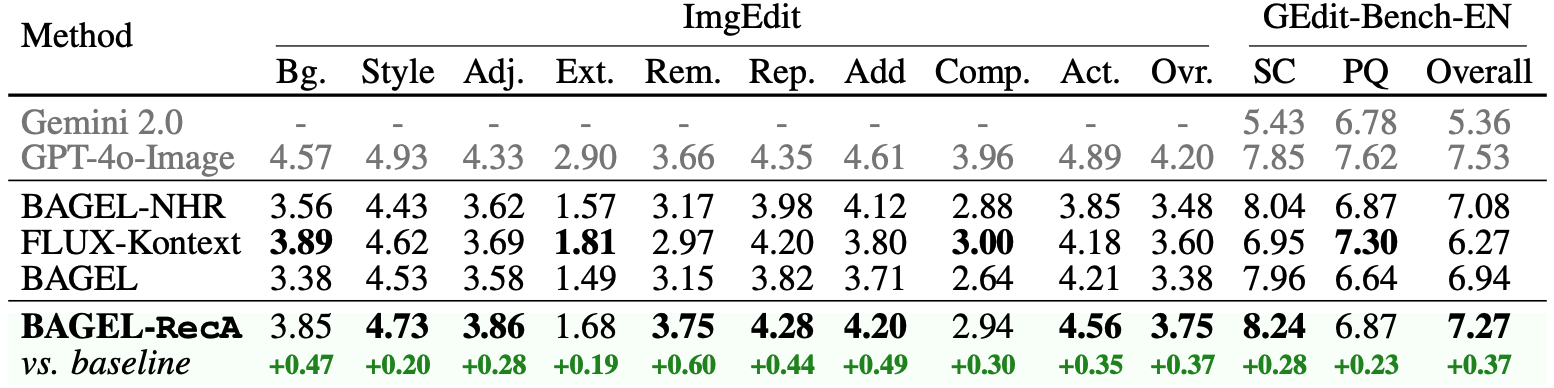
Image editing
BAGEL → BAGEL + RecA
This BAGEL experiment uses 10,000 unlabeled images, 1,000 training steps, and 27 A100 GPU-hours.
Full benchmark tables & per-category results
04 / Image editing
A new light. A different detail.
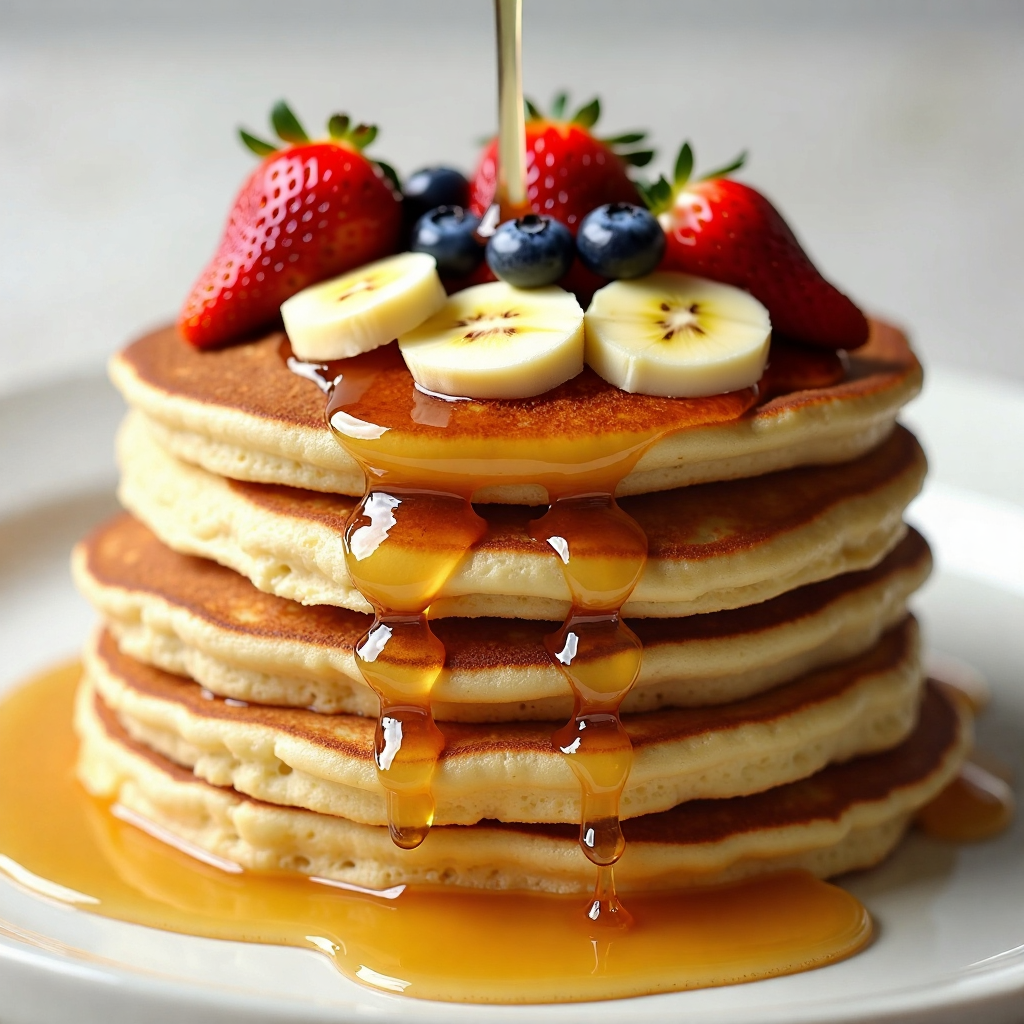
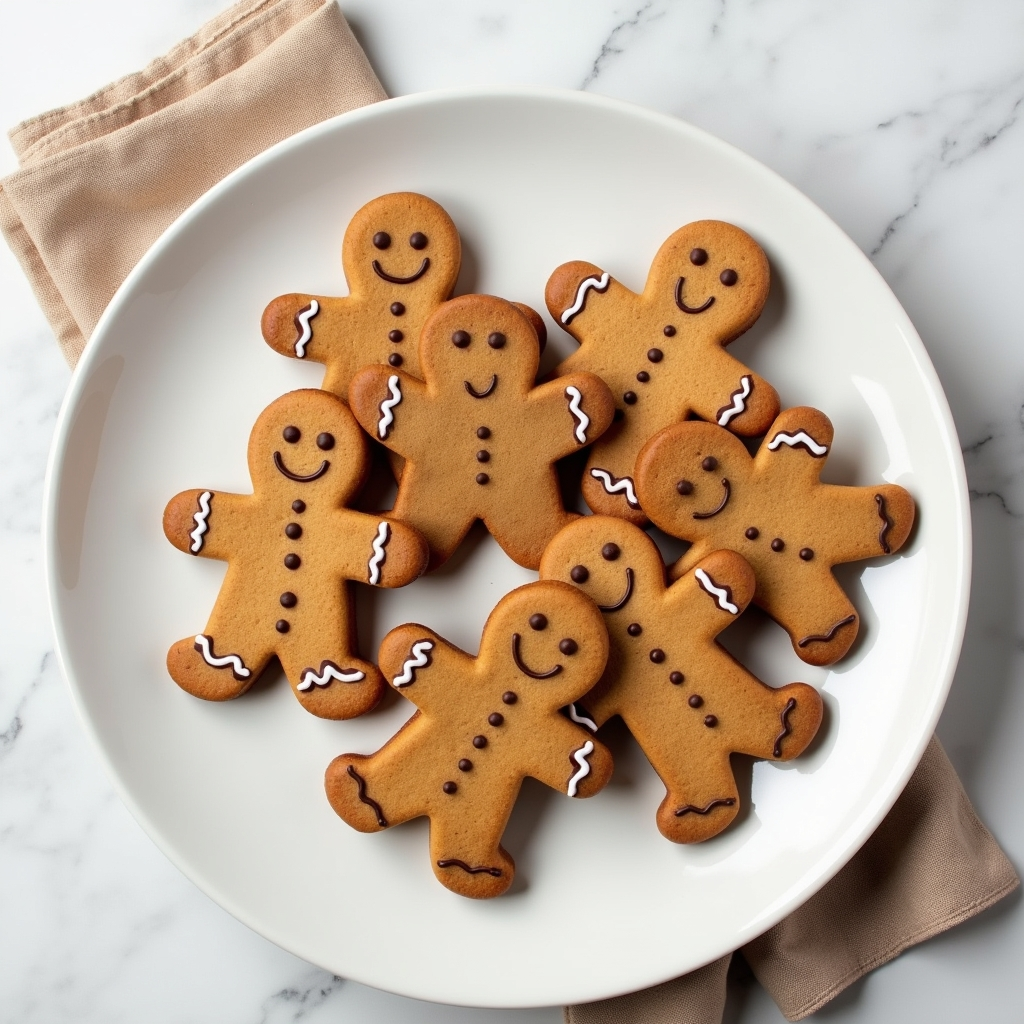
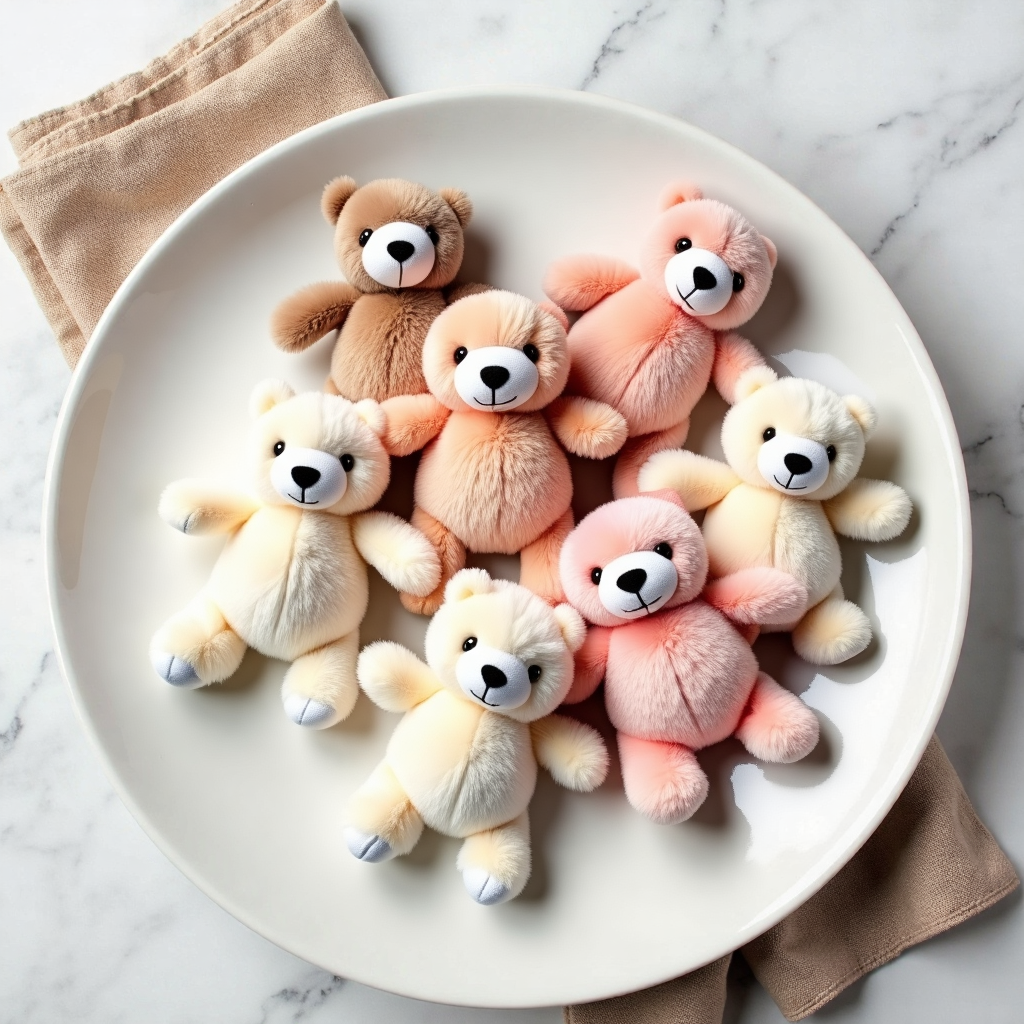
BAGEL-RecA editing examples. Drag the divider to compare the original image and the edited result.




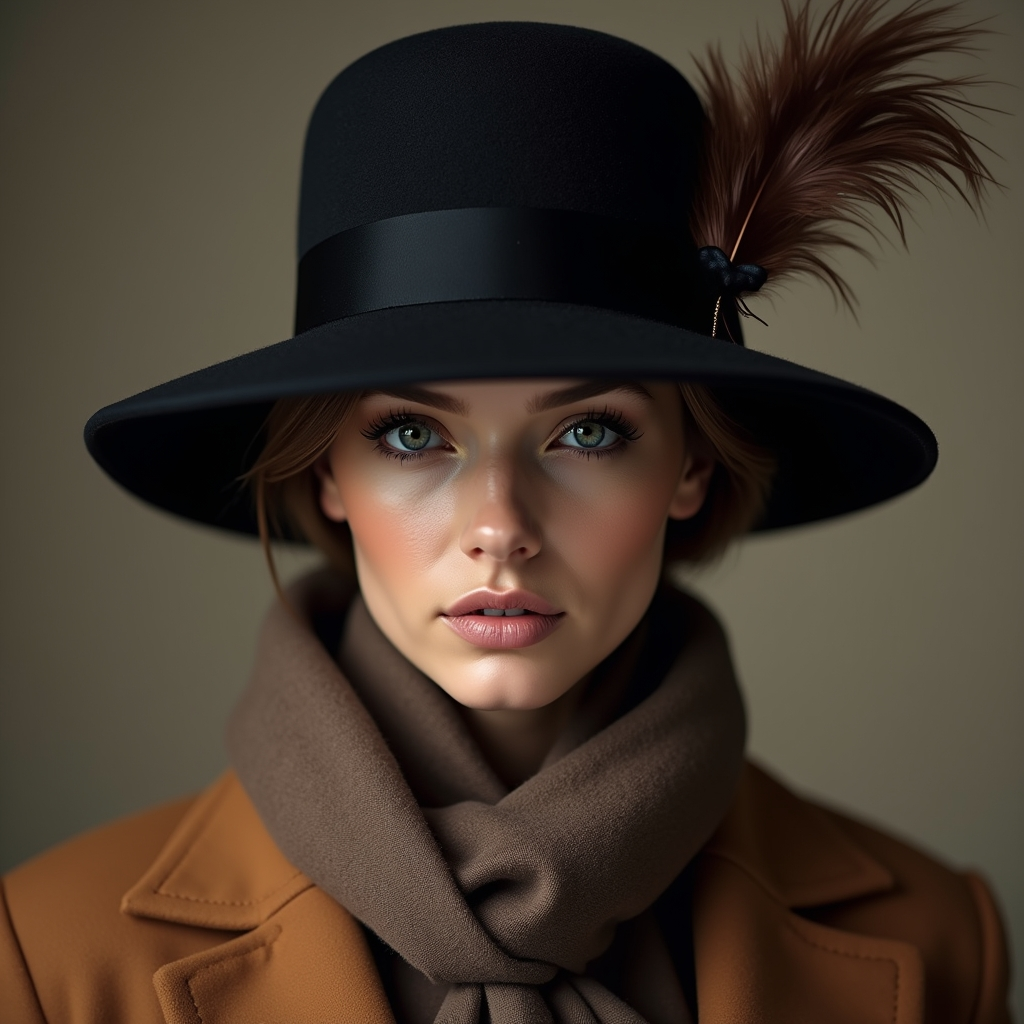
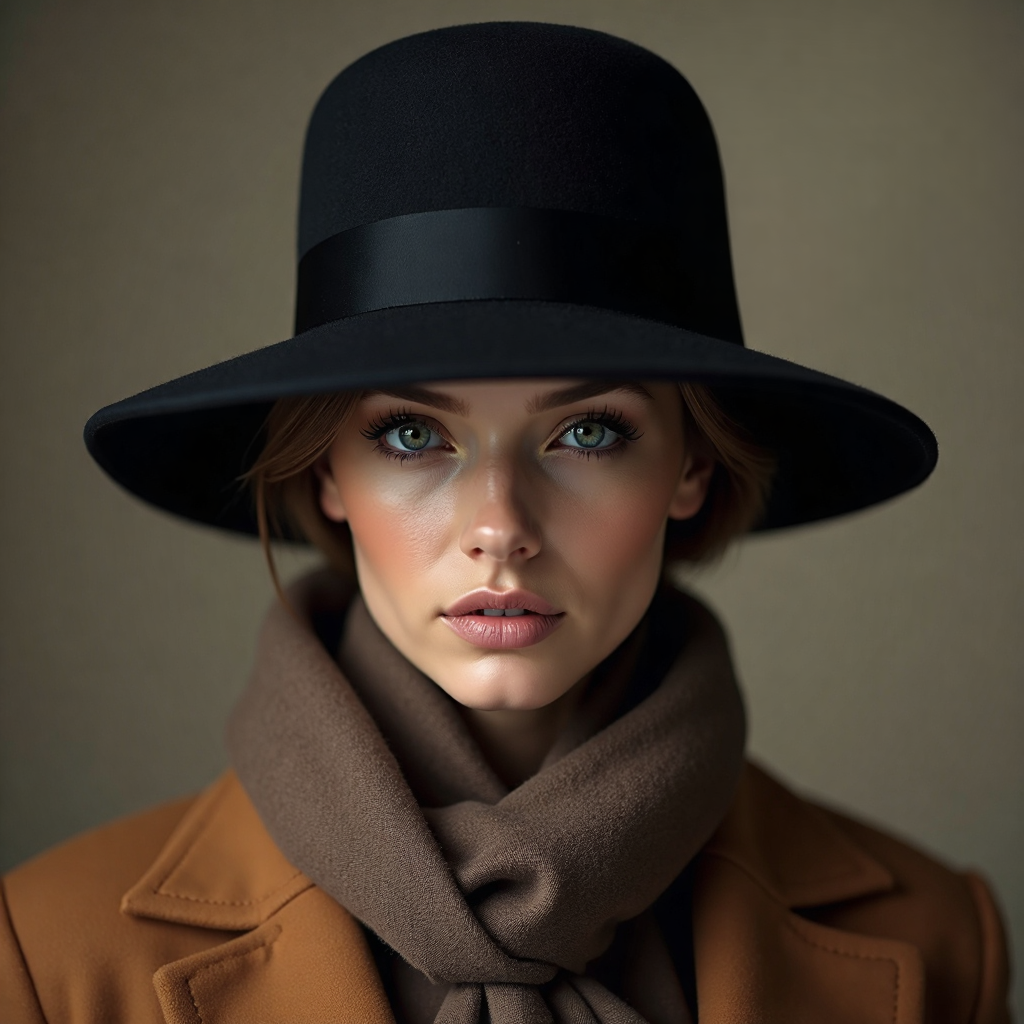
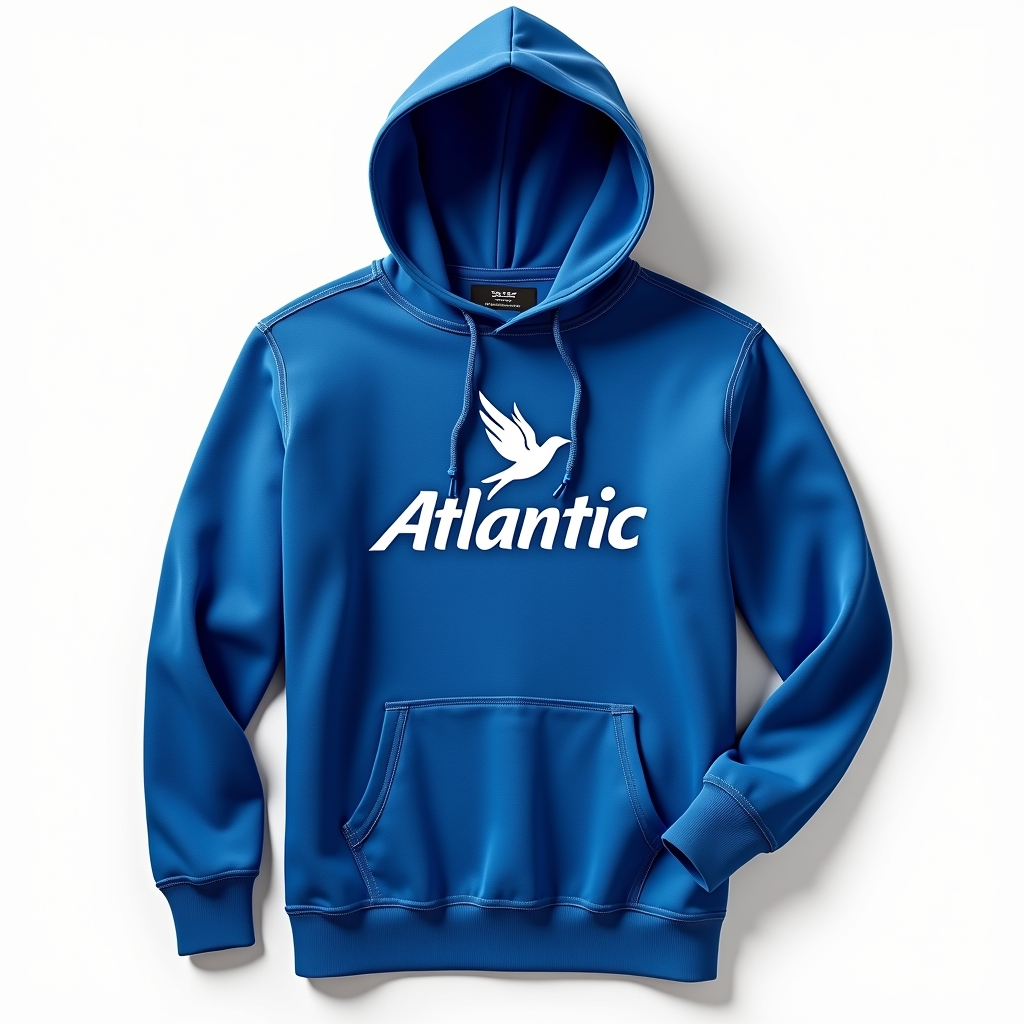

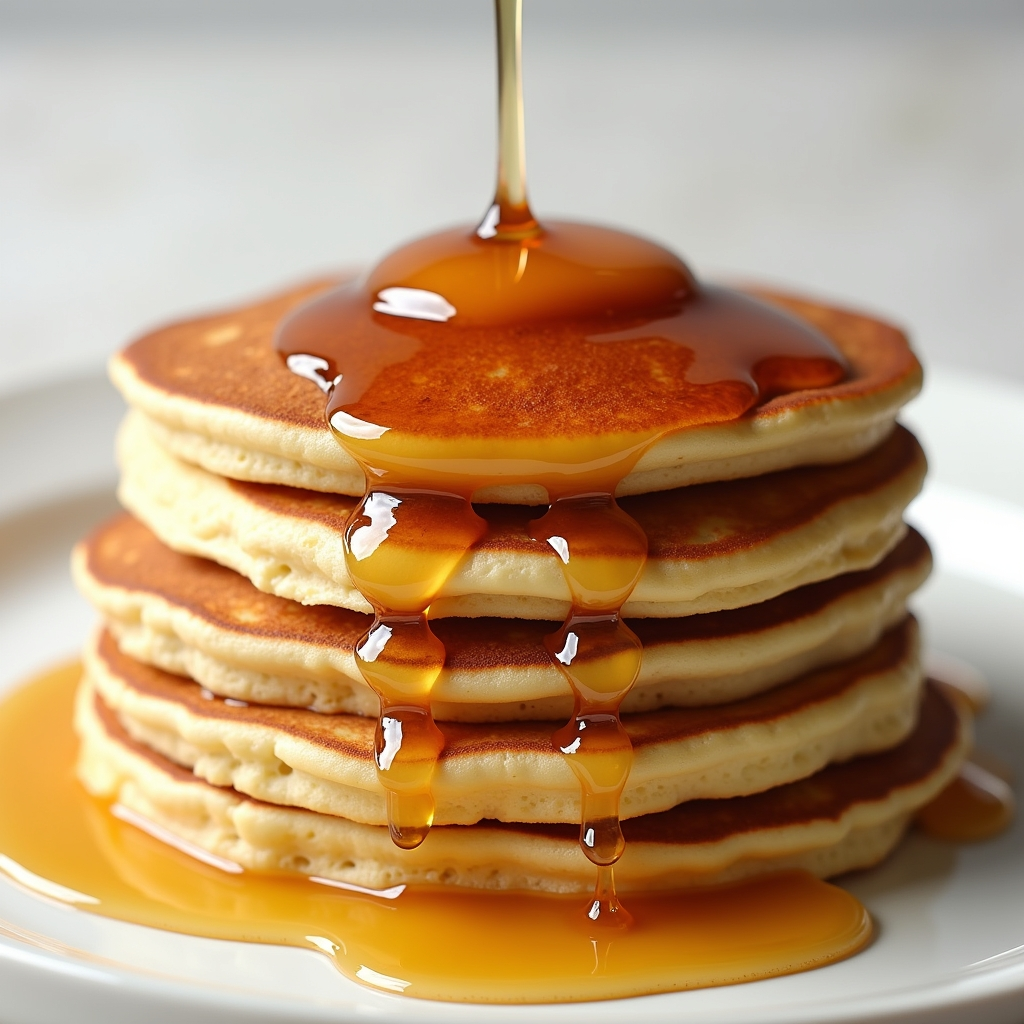
Keyboard: focus a comparison and use the arrow keys. Try BAGEL-RecA ↗
05 / Citation
Build on this work.
If RecA is useful or inspiring for your research, please consider citing our ICLR 2026 paper. Abstract & publication details ↗
@inproceedings{xie2026reconstruction,
  title={Reconstruction alignment improves unified multimodal models},
  author={Xie, Ji and Zettlemoyer, Luke and Wang, Xudong and others},
  booktitle={International Conference on Learning Representations},
  volume={2026},
  pages={120095--120137},
  year={2026}
}